


Tools

Slugline. Simple, elegant screenwriting.

Red Giant Color Suite, with Magic Bullet Looks 2.5 and Colorista II

Needables
  • Sony Alpha a7S Compact Interchangeable Lens Digital Camera
    Sony Alpha a7S Compact Interchangeable Lens Digital Camera
    Sony
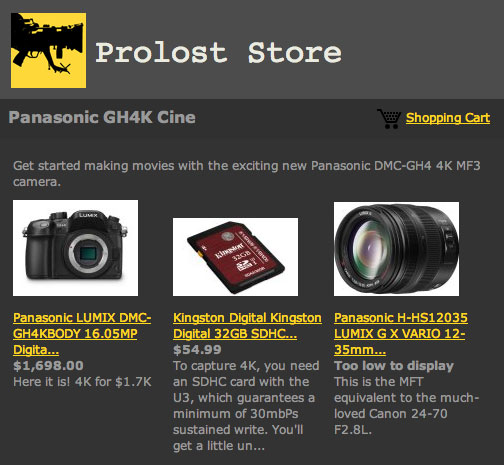
  • Panasonic LUMIX DMC-GH4KBODY 16.05MP Digital Single Lens Mirrorless Camera with 4K Cinematic Video (Body Only)
    Panasonic LUMIX DMC-GH4KBODY 16.05MP Digital Single Lens Mirrorless Camera with 4K Cinematic Video (Body Only)
    Panasonic
  • TASCAM DR-100mkII 2-Channel Portable Digital Recorder
    TASCAM DR-100mkII 2-Channel Portable Digital Recorder
    TASCAM
  • The DV Rebel's Guide: An All-Digital Approach to Making Killer Action Movies on the Cheap (Peachpit)
    The DV Rebel's Guide: An All-Digital Approach to Making Killer Action Movies on the Cheap (Peachpit)
    by Stu Maschwitz

Entries in Cameras (151)

Saturday
Sep272008

Comment your way to 24p UPDATED


OK, I’ve asked you to call, I’ve encouraged you to write. May I ask you for one last favor regarding the Canon 5D Mark II? Please head over to the blog of Vincent Laforet, creator of Reverie, and post a comment telling Canon how much you want 24p and manual shutter control.

Vincent writes: 

As far as 24p - I know they’re listening (Canon that is) - but they NEED TO KNOW just how important this is to everyone - including me..

So this may be a little silly - but let’s get AS MANY COMMENTS on this blog - possible… let’s break 300 or 400 comments - asking simply: WE NEED 24P etc etc… keep it simple - the idea is for them to see how overwhelming the need for this feature is - it is in my opinion the single most important feature request…

So go ahead… request it… one comment at a time (only one comment per person please :)


24p and 1/48th is key… keep going… they will understand that it’s a MUST do firmware update…
I understand that it’s a silly tactic - but it works a LOT better than a carefully crafted e-mail or letter… trust me. If we hit 500+ comments asking for 24p - they can’t ignore it.


This is great that Vincent realizes the importance of a 24p mode, and of full manual control for movie capture. Support him, post a comment, and help Canon help themselves right into the forefront of the revolution.

UPDATE: It might be working guys. From canonrumors.com: 

From Laforet’s blog


“One of the visitors of Photokina 2008 Trade Show in Cologne reported in a well known German Canon forum today (http://www.dforum.net/), that Canon is now actually discussing a firmware upgrade to enable 25 fps mode. Furthermore, the Canon technician, who revealed this information, confirmed, that the 25 fps can be achieved by firmware change only, no hardware modifications are required.”

I’d direct link but I couldn’t actually find that on Laforet’s blog—must be buried in the hundreds of comments?

Monday
Sep222008

Reverie

Image © Vincent Laforet

Vincent Laforet has a posted stunning new video made during the brief 72 hours for which he managed to get his hands on a pre-release Canon 5D Mark II.

You’ll immediately notice two things about it. I mean, once you get past the Moby soundtrack and helicopter shots:

  • It’s gorgeous and
  • It looks like video.

There are two reasons for the latter. The first, as previously discussed, is that it’s shot and shown at 30 fps.

But even more responsible for the video-like appearance of some shots is the shutter interval. Film usually has a shutter speed of 1/2 the frame duration, e.g. 1/48 second shutter speed for 24 fps. Video, unencumbered by a physical shutter, often has a shutter speed equal to the frame rate. The most video-like sections of Vincent’s short are those with 1/30th shutter speeds.

This issue plagues many 24 fps HD examples as well. Even at 24p, a “360 degree shutter” results in too-smooth motion with a video-like appearance. You may have seen this in some Hollywood movies shot with 24p HD cameras. It’s not the dynamic range or resolution that blows it for digital movies—it’s a simple choice to use a shutter speed impossible on a film camera.

I’m not trying to critique Vincent’s beautiful piece at all, just hoping to preemptively answer the question of why some 30p samples can indeed look filmic, and some don’t.

I’m also seizing this opportunity to discuss the 360 degree shutter issue, as it’s one that needs airing out. Sure, it may be a creative choice for a filmmaker to use a greater-than-180-degree shutter, but when my mom sees the trailer for Collateral and asks me why it looks like video, we’re talking about a choice that sets back the progress of digital cinema. If you want your 24p HD to look like film, the film we know and love, stick to a 1/48 second shutter speed or faster.

It gets right back to good old less is more—not only is 24p a minimal frame rate, it turns out that a big part of the signature film look is that you only see half the motion in each of those 24 frames per second.


In other words, 24p is only one part of what the filmmaker needs from an HD-equipped DSLR—another, equally important component is manual control, specifically the ability to enforce a 180 degree (1/48 at 24p) shutter speed.

Monday
Sep222008

My letter to Canon

Photo by Benjamin Warde of me making this shot.

The person I spoke with at Canon’s help line did not give me the greatest sense of confidence in their ability to impart my 24p request, so I took reader prosckes’s advice and emailed Canon at customerfeedback@cits.canon.com:

Dearest Canon,

I am an author, filmmaker, and photographer. I use my 5D almost every day and own several video cameras as well (including one from Canon). The filmmaking community is very excited about the 5D MarkII’s HD video mode. It is a very important development that many, including myself, see as signifying an eventual loss of distinction between video and still cameras. It is wonderful that Canon is a part of this revolution.

I realize that despite the excitement surrounding this new capability, video is a “bonus” feature on the 5D MkII. Nevertheless, it’s a bonus feature that will sell some cameras. In my own case, the HD video feature would be enough for me to immediately upgrade from my current 5D to the MkII. Except for one crucial problem: the frame rate.

It was a natural choice to offer 30 fps video, as it roughly matches the broadcast frame rate in both the US and Japan. But we filmmakers would love to have the option of 24 fps. This is the frame rate of motion picture film. Until HD video cameras adopted this frame rate (which came to be known as 24p, the “p” standing for Progressive Scan), they were not taken seriously by the film industry.

Canon’s pro video division understands this, perhaps painfully. Canon was once the darling of the independent video community, but being late to the table with a real 24p video solution meant a lot of lost business to Panasonic and Sony. Now even very low-end Canon video cameras have 24p support, although Canon is still not perceived as a leader in this area.

And while the 5D MkII is in a different class than the Nikon D90 DSLR, the D90’s video mode, while only 720p and marred by motion artifacts, is 24 fps. This is important enough that many people are buying the D90 based on this feature alone. At the same time, Panasonic’s compact LX3 also features 24p video at 720p HD resolution. Other manufacturers know what Canon’s pro video division knows: 24p is a must-have option in an HD camera.

Meanwhile, Jim Jannard of RED is scrapping his plans for a much-anticipated $3,000 video camera, based, no doubt, on the sudden explosion of large-sensor motion options cropping up at or below that price point. He has thousands of potential customers waiting to buy whatever he makes instead.

You need to be as much of a leader in this exciting new movement in camera technology as you are in the DSLR world. Please add 24p support to the 5D MkII via a firmware update. If you do, I will upgrade immediately. If you don’t support 24p, someone else will, and my business and allegiance will go with them. This is a critical time for Canon to establish leadership and show an understanding of its users’ needs.

And now for some specifics: While 30 fps is useful, it would be better if the camera ran at 29.97 fps, the actual speed of NTSC video. Similarly, when I say 24p, I am really talking about 23.976 fps. In Europe, users will want a 25 fps mode for compatibility with PAL video. Again, none of this is news to your pro video division.

For more information on this subject and to read some comments from supporters and potential customers, please see my blog:

So Close Canon

OK guys, if you’re serious about this…

Thanks for your time and attention,

-Stu


Stu Maschwitz
www.theorphanage.com
www.prolost.com

Monday
Sep222008

OK guys, if you're serious about this...


From letsgodigital.org:

During a Panasonic Press event, at which the new Micro Four Thirds system was evaluated and further explained, Panasonic also revealed the development in process of a new Micro FourThirds system camera. Panasonic already claims that it will introduce the world's smallest High Definition system camera in 2009.


Apparently Panasonic is also a believer, touting an SLR-esque camera in which HD video is more than just an afterthought. Nice to see, considering that Panasonic's debut offering in this format has no video mode at all. The compact, mirorless Micro Four Thirds system is probably closer to the eventual collision of digital cinematography and stills systems than traditional DSLR designs are.

So, Panasonic, Nikon, Canon and anyone else who wants to dip their SLR chocolate into the HD peanut butter, here's what you need to do (and what Jim Jannard of RED already knows):

Everything that matters to a photographer matters to a filmmaker/videographer. The exact features that set a DSLR apart from a point-and-shoot put the "pro" in prosumer HD cameras. It basically boils down to quality and control, but here are a few more specifics to bear in mind—if you're serious:

  • Adopt a known video standard that is compatible with current NLE software. A good one. But go big—consider a "visually lossless" codec.
  • Use frame rates that make sense. 24 fps is great, 23.976 fps is better. Same with 30 and 29.97. Filmmakers often shoot funky frame rates for effect, anywhere between 1 and 72 fps. And sometimes much much more.
  • No pixel binning or other dirty tricks for hurrying the data off the sensor—give us the best stuff your sensor is capable of. Capture the full resolution and downsample to video res. Or don't—1080p is not the top of the food chain, just ask RED.
  • DSLRs eat and sleep raw. Consider a lightly-compressed DNG sequence output as an option. At the very least, offer RGB compressed video at a wide-gamut, minimum-processing color space. Let us turn down sharpening and other "enhancements" and record something that gives us room to play in post—just like we do with stills.
  • Somehow we have to focus when shooting video. The screen on that Lumix G looks mighty big, but can I make critical focusing decisions with it? Maybe I could with focus assist features that are commonplace on HD camcorders.
  • Jello-cam is not OK.

But more important than any of that: Give us control of our cameras—that same control that makes the SLR experience what it is. Video is not a "mode" on a dial that you select instead of manual control.When we're shooting video, we'd like to control the camera in the exact way we do when recording stills, not via some arcane menu.

The first one who gets this right changes everything.

UPDATE: Speaking of changing everything, read the comments below. Jim has scrapped the current Scarlet design and is starting fresh. What do you wanna bet it looks a bit more like the above?