


Tools

Slugline. Simple, elegant screenwriting.

Red Giant Color Suite, with Magic Bullet Looks 2.5 and Colorista II

Needables
  • Sony Alpha a7S Compact Interchangeable Lens Digital Camera
    Sony Alpha a7S Compact Interchangeable Lens Digital Camera
    Sony
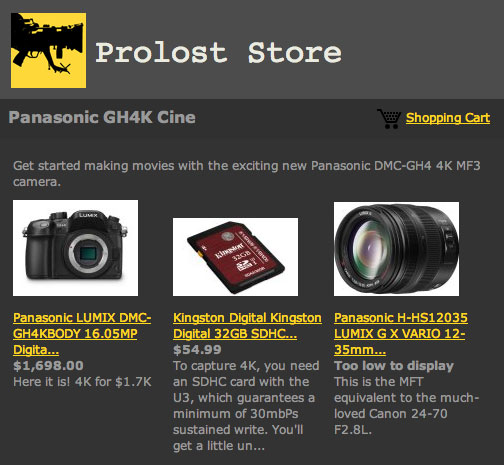
  • Panasonic LUMIX DMC-GH4KBODY 16.05MP Digital Single Lens Mirrorless Camera with 4K Cinematic Video (Body Only)
    Panasonic LUMIX DMC-GH4KBODY 16.05MP Digital Single Lens Mirrorless Camera with 4K Cinematic Video (Body Only)
    Panasonic
  • TASCAM DR-100mkII 2-Channel Portable Digital Recorder
    TASCAM DR-100mkII 2-Channel Portable Digital Recorder
    TASCAM
  • The DV Rebel's Guide: An All-Digital Approach to Making Killer Action Movies on the Cheap (Peachpit)
    The DV Rebel's Guide: An All-Digital Approach to Making Killer Action Movies on the Cheap (Peachpit)
    by Stu Maschwitz

Entries in Cameras (151)

Wednesday
Nov052008

Three Simple Things

Recently I was asked by a major DLSR manufacturer what features I would like to see in their movie capture mode. I pledged to restrict my reply to things that I presumed (in my ignorance) could be accomplished in firmware. Here’s what I sent:

  • Choice of frame rate. Ideally we would be able to choose any frame rate from 1 to 30, with special cases for the NTSC speeds for 30 and 24 (which are 29.97 and 23.976 fps, respectively). But the “most wanted” frame rates are 29.97, 23.976 and 25 fps. 60 fps would be nice to have for slow motion, even if it had to be 720p.

    But 23.976 is the most important frame rate to support. It is worth mentioning that Getty Images now only accepts footage shot in 24p!
  • Manual control, ideally using familiar camera controls, of aperture, shutter, and ISO.
  • There is one additional feature that is probably slightly less accessible, but is nevertheless an important issue to explore. I have no problem with manually focusing while in video mode, but the challenge is that the rear LCD display, glorious though it may be, is not sufficient for gauging focus at 1080p. An edge-enhancement focus assist option of the kind found on many HD video cameras would be ideal. I quite like the one on the Sony EX1—it displays a colored outline on sharp edges.
To recap
  • 24p
  • Manual exposure
  • Focus assist
My Amex awaits!

I hope they’re listening. I keep holding up the boombox, but I don’t see much movement in the window.

I’ve also mentioned to anyone who will listen that it’s time for video cameras to respond to this DSLR excitement. There’s much more than the mere ability to record video that defines a video camera. Some big challenges lurk here though. A Sony EX1, with its amazing, filmmaker-friendly features but miniscule sensor makes a luxurious DSLR like the 5D MkII seem downright affordable, even with its L-series kit lens included. Remember that only Panasonic has shown a video-focussed SLR-esque camera. As a SLR replcement, its predecessor, the Lumix DMC-G1, has been criticised for being too big. As a video camera it borders on being too small, although that is easily fixed. The Micro Four Thirds sensor is almost as big as the RED One’s, and Panasonic knows how to make video cameras for filmmakers. The G1 with lens is cheaper than the Nikon D90. No word on price for the video variant.

A week from tomorrow RED will blow us all away with their latest announcements and the future will seem both closer than ever, and farther away as well.

In the meantime, these video SLRs could be an aweful lot of fun—if they’d just do three simple things.

Monday
Oct272008

Reason #3

...not to buy the new Panasonic G1, according to David Pogue's NYT review:

The Micro Four Thirds design screams out, “I can do video!” After all, the light is already shining directly on the sensor (instead of being blocked by a mirror), so this camera should be able to record video without batting an eye.

But the G1 can’t.

Video, Panasonic says, will be the emphasis of its 2009 models. They will be the first S.L.R.-type cameras that can not only record hi-def video, but also change focus and zoom while you’re recording, just like a camcorder. (Olympus’s prototype can do video, too.)

This kind of talk makes me giddy. If it’s all true, then these machines will be the world’s first no-compromise, combination still camera/video cameras. The electronics world will truly turn upside down. Watch this space.


Indeed.

Monday
Oct272008

Scarlet Specs Countdown, OpenCut 3

RED will release the revised specs for Scarlet and Epic on November 13th.

OpenCut 3
is a VFX challenge, create and composite backgrounds for a scene shot against a vaguely greenish screen. Doesn’t seem quite the creative win-win of previous OpenCut contests (although you can win Adobe Creative Suite 4: Master Collection and one week’s free rental of a RED One), but I encourage you to enter if only to learn why I recommend in The Guide that you stay away from virtual backgrounds if at all possible!


OpenCut 3 - Sensored REDVFX Challenge from Silverado on Vimeo.

Friday
Oct242008

October 19, 2008


October 19, 2008 from angus giorgi on Vimeo.

Another 5DMkII showreel.

There's some good info on the Vimeo page, as well as some incorrect statements. "Panning too quickly on 35mm produces stepping effects that you don't get on 16mm film"—I have no idea how that could be true. But the general sentiment is spot on. SLRs are an inch away from being mini movie cameras that create images more cinematic in feel than many video cameras costing ten times as much.

Same thing as Reverie—wanna know why, as lovely as it is, this video looks like video? Read this.

Thanks to reader Greg for the comment that brought this to my attention!

UPDATE: Check the comments for a password protected (why?) D90-lensed music video (try the password all lowercase). You will note that a careful DP seems to have enforced a 180 degree shutter equivalent or narrower. That along with the 24 fps frame rate makes this look much more film-like than anything we've seen from the 5D2. Don't be fooled by the film leader overlays, that's not as responsible for the film look as some would like to believe (although it's perfect evidence that we just can't get enough image degradation!). Attribute the cinematic feel more to the lighting, and the color correction. The D90 can be configured to shoot video that's much more friendly to post color work than can the 5D2, which bakes in a harsh contrast.

No jello-cam to be seen—as I twittered a while back, the funny thing about Jellocam is that it's remarkably easy to shoot a test that amply shows it off and in no way resembles anything you'd ever actually shoot.

UPDATE 2: Director Ramon Boutviseth is discussing the D90 shoot on DVXuser.com. What I described above as the actions of a careful DP, he describes thusly: "most challenging would be the exposure, I shoot on Auto because I don't know how to work the other modes yet, I aim the camera into the light and hold exposure lock to get the picture."